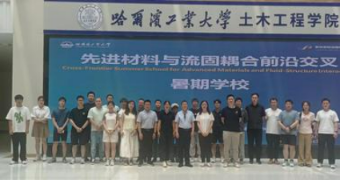
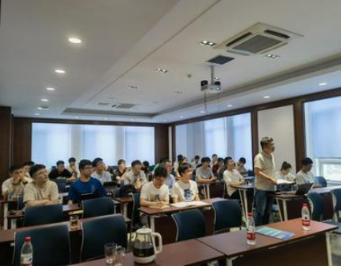
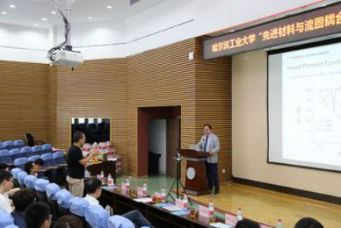
From the vast scale of the Milky Way to the micro- and nano-structures of advanced materials, fluid–structure interaction (FSI) phenomena manifest in remarkably diverse and fascinating ways. The physicochemical properties of materials directly influence fluid behavior, while the surrounding fluid environment significantly impacts material forming processes, long-term durability, and performance evolution. In advanced materials, complex multi-physics couplings, encompassing mechanical, electrical, magnetic, thermal, and chemical fields combined with FSI effects are ubiquitous across aerospace engineering, civil infrastructure, biomedical devices, and many other critical domains. In recent years, China has achieved a wealth of groundbreaking advances in this field, laying a solid foundation for future innovation. To further strengthen fundamental and interdisciplinary research at the frontier of advanced materials and fluid–structure interaction and foster in-depth exchanges between young researchers and leading scholars, we held the Summer School on Advanced Materials and Fluid–Structure Interaction: Frontiers in Interdisciplinary Research at Harbin Institute of Technology (HIT) from July 10 to 17, 2024. This initiative aims to establish a high-level platform for knowledge dissemination and academic exchange, promote the translation of fundamental research into practice and accelerate the development of interdisciplinary research in this vital area.
The summer school invited 28 distinguished scholars, including Academician K.C. Kim to deliver a total of 64 instructional hours. The curriculum covered foundational theories at the intersection of advanced materials, fluid mechanics, and FSI; methodologies for structural characterization and design of advanced materials; and engineering application technology. It distilled key fundamental scientific questions and innovative research methodologies, explored complex flow phenomena, novel theories and approaches in fluid–structure interaction, new physical properties of advanced materials, and emerging strategies for enhancing material performance, while also examining cutting-edge technologies and their innovative applications.
A total of 103 applicants registered, with 97 participants ultimately attending, primarily senior undergraduates, master’s and doctoral students, and early-career faculty from disciplines including mechanics, civil engineering, aerospace engineering, physics, and materials science. In addition to lectures, the program featured specialized seminars, laboratory visits, including the wind tunnel facility and the School of Civil Engineering History Exhibition Hall and interactive discussions, enriching participants’ academic and campus experiences.
Through in-depth exploration of frontier topics, such as advanced FSI theory, microstructural characterization techniques for advanced materials, and the design principles of smart material systems, the summer school provided an exceptional platform for academic and technical exchange. It successfully promoted interdisciplinary integration across fundamental sciences and contributed actively to advancing China’s foundational research capacity and the development of high-end advanced materials.