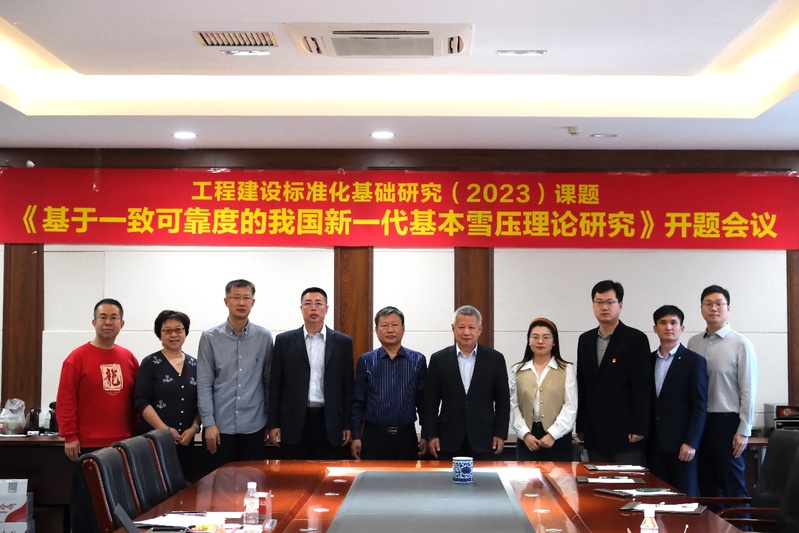
On March 25, 2024, the kick-off meeting for the Key Basic Research Project on Engineering Construction Standardization (2023) entitled Theoretical Study on a New Generation of Basic Snow Load in China Based on Uniform Reliability led and hosted by Professor Fan Feng of the School of Civil Engineering, Harbin Institute of Technology, was successfully held in Conference Room 217 of the Civil Engineering Research Building. The expert panel for the kick-off meeting consisted of Professor Li Fanghui from Heilongjiang University, Research Fellow Liu Chunsheng from the Heilongjiang Climate Center, Associate Research Fellow Li Honghai from the China Academy of Building Research, and Professor Wu Yue and Professor Sun Xiaoying from Harbin Institute of Technology. Representatives of the commissioning organization—the Institute of Standards and Norms, Ministry of Housing and Urban-Rural Development (MOHURD)—including Liu Yuefei, as well as all members of the research team, attended the meeting. Professor Li Fanghui, head of the expert panel, chaired the meeting.
In his opening remarks, Liu Yuefei provided a detailed introduction to the background, objectives, and project approval process of the Engineering Construction Standardization Basic Research Program, and expressed the expectation that the research team would conduct systematic planning, make sound arrangements, and ensure the smooth and effective implementation of the project in accordance with the approved research plan. Professor Fan Feng, the project leader, introduced the overall framework of the project, expressed his gratitude to the Research Institute of Standards and Norms Ministry of Housing and Urban-Rural Development for its trust and to the expert panel for their guidance, and stated that the research team would complete the project with high standards and quality as scheduled, contributing to the advancement of China’s engineering construction standardization.
Mo Huamei, a member of the research team, presented the research background and significance, research content and technical approach, feasibility and existing research basis, as well as the research objectives and implementation schedule. Based on the presentation, the expert panel conducted inquiries and in-depth discussions on the overall research scheme and work plan, and put forward valuable suggestions. The expert panel concluded that the research objectives are clear, the overall technical scheme is sound, and the work plan is feasible. The project is supported by solid preliminary research, and the host institution possesses strong disciplinary support and research capacity, fully meeting the requirements for undertaking the project. The panel, therefore, agreed to initiate the project formally.