Hosted jointly by the School of Civil Engineering of Harbin Institute of Technology and the School of Civil Engineering and Architecture of Xiamen University of Technology, the 4th Academic Symposium on Testing and Analysis of Modern Concrete Microstructure was successfully held in Harbin from December 20 to 22, 2024. The symposium attracted 164 experts, scholars, university teachers and students from 22 provinces, municipalities directly under the Central Government and autonomous regions across China. Focusing on the scientific research of concrete materials and the development and application of testing technologies, this academic symposium aimed to build a platform for cutting-edge academic exchange and discussion.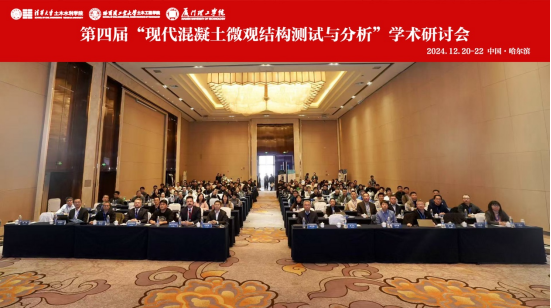
The opening ceremony of the symposium was presided over by Professor Zhou Chunsheng from Harbin Institute of Technology. At the ceremony, Professor Yan Peiyu, Chairman of the Academic Committee and from Tsinghua University, and Professor Chen Wenli, Dean of the School of Civil Engineering of Harbin Institute of Technology, delivered speeches successively. They emphasized the important significance of concrete science development, technological innovation, and microstructure testing and analysis in engineering practice and scientific research, and expressed the hope that the symposium would help promote the development of modern concrete science and technological innovation.
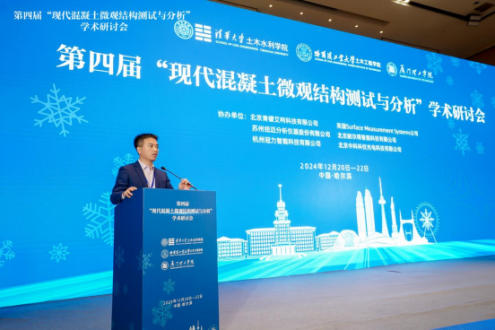
Professor Zhou Chunsheng presided over the opening ceremony
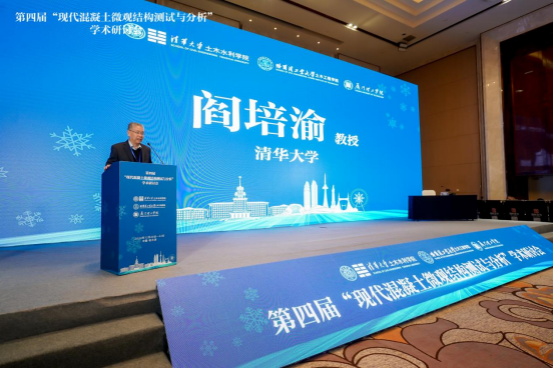
Professor Yan Peiyu delivered a speech
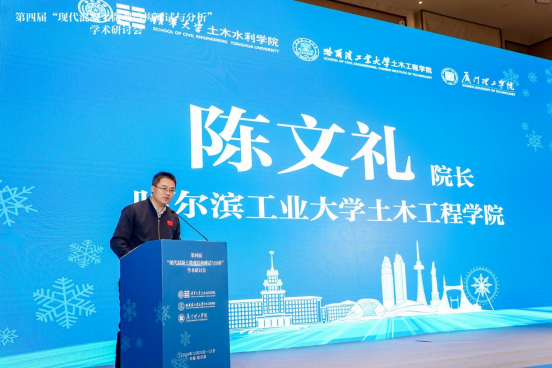
Dean Chen Wenli delivered a speech
During the conference, a total of 27 brilliant academic reports were focused on the testing and analysis of cementitious material hydration and microstructure development, interface and crack damage, multi-scale pore structure, moisture and ion transport, steel corrosion and other related aspects. These reports probed deeply into the development and application of traditional testing technologies in this field, as well as the latest research findings of cutting-edge testing and analysis methods. Distinguished experts including Professor Kong Xiangming from Tsinghua University, Professor Zhang Zuhua from Tongji University, and Professor Wang Chong from Chongqing University took the floor successively. They shared their pioneering research achievements, such as characterizing cement hydration processes and the effects of additives like cyclodextrins using low-field nuclear magnetic resonance technology, efficient testing and analysis of the chemical structure of aluminosilicate cementitious materials, and testing, evaluation, prevention and control of sulfate attack in low-temperature environments. These presentations fully demonstrated the innovative application of testing and analysis technologies in the characterization of modern concrete microstructure and the evaluation of its macroscopic properties. Each report was allocated 30 minutes (including 8 minutes for Q&A). The interactive sessions were marked by a vibrant and lively atmosphere of discussion. Experts in attendance engaged in heated exchanges centering on testing methods and research ideas, which were so enthusiastic that the host had to intervene frequently to keep the conference proceeding as scheduled. The participants were still in high spirits and reluctant to end the discussions when the sessions transitioned to coffee breaks or meals.
Kong Xiangming Zhang Zuhua Wang Chong
Tsinghua University Tongji University Chongqing University
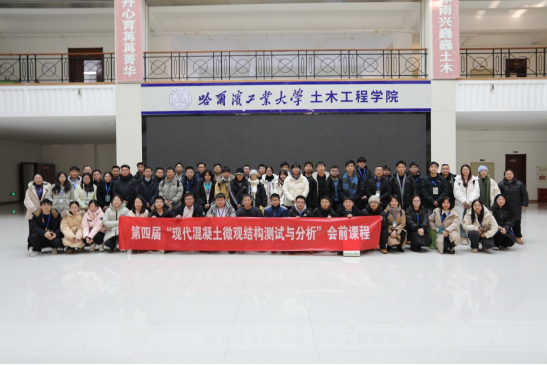
Prior to the academic symposium, the organizing committee specially held a thematic course on low-field nuclear magnetic resonance and electrochemical impedance spectroscopy testing technologies, which attracted the enthusiastic participation of more than 70 teachers and students from universities across the country. The pre-symposium thematic course was taught by Professor Zhou Chunsheng from Harbin Institute of Technology and Professor He Fuqiang from Xiamen University of Technology. Combining theoretical explanation, practical operation and case demonstration, the course elaborated on the basic principles, key points of testing and analysis, as well as cutting-edge applications of the two micro-testing technologies, effectively helping the participants understand and master the relevant testing technologies and analysis methods.